PRESS RELEASE
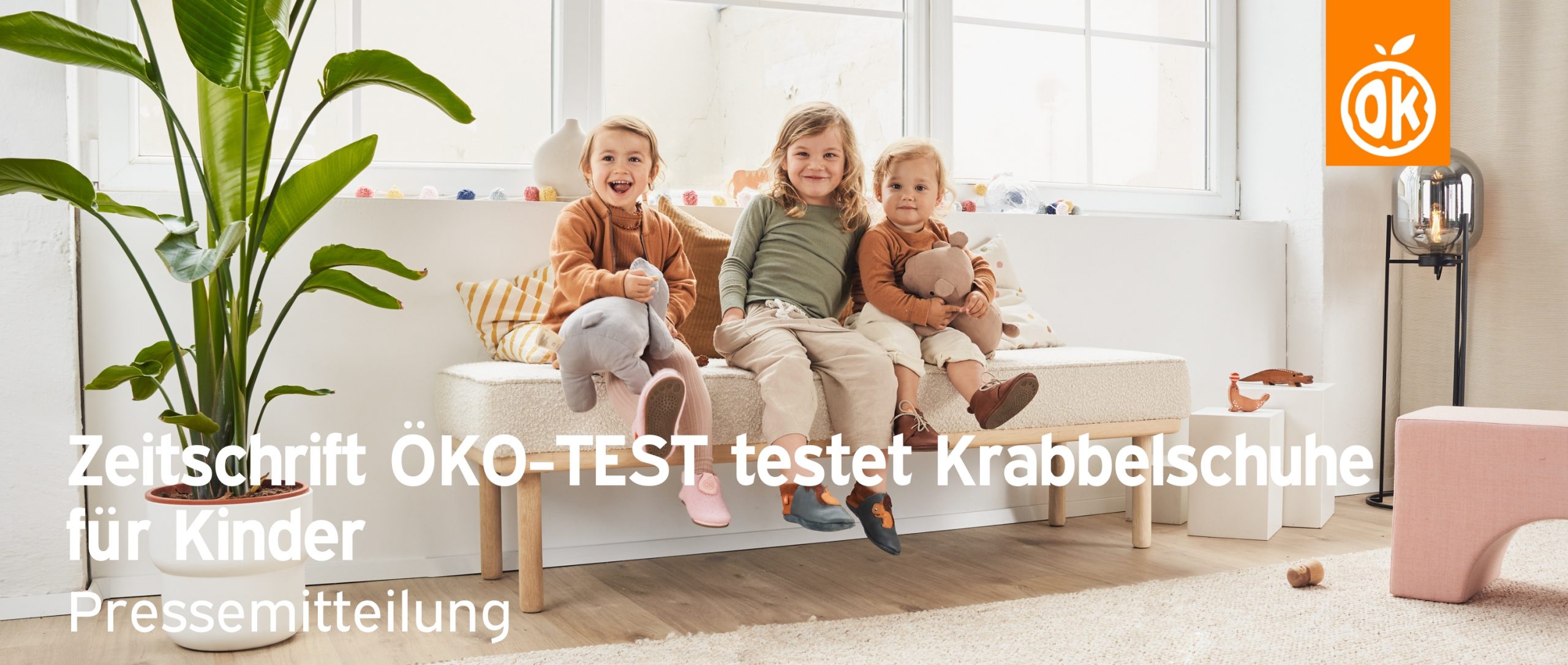
Öko-Test magazine tests crawling shoes. The tested shoes from Orangenkinder clearly meet all legal requirements and stand out due to the use of chrome-free leather and the elimination of optical brighteners. Orangenkinder criticizes the Ökotest’s own limit values used in the test.
Oberreichenbach, 08.02.2023. The Ökotest magazine (issue 2/2023) tested 12 pairs of crawling shoes for children, including shoes from Orangenkinder (Carney GmbH & Co. KG). The tested Orangenkinder shoes “Bärnie Honigbär” meet all legal requirements for ingredients and limit values. According to Ökotest, which rated it positively, Orangenkinder is one of the few suppliers to use chrome-free tanned leather and no optical brighteners. In the overall test, Ökotest criticizes the aniline value in every second pair of shoes and therefore gives the grade “Insufficient” six times. The aniline value for Orangenkinder shoes is 25mg/KG, which is below the legal maximum value of 30mg/kg.
____________________________________________
UPDATE!
December 2023
For the 2024 annual edition – Yearbook Children and Family – the Orangenkinder shoes “Bärnie der Honigbär” were tested again by Ökotest.
CONCLUSION:
-No aniline detectable (n.n.)-
Overall rating:
GOOD
____________________________________________
Points of criticism in the test: Aniline values
– No aniline detectable (n.n.) –
No aniline was found in the shoe
Verena Carney, Managing Director of Orangenkinder: “We are proud that Ökotest tests our products, because it shows that the market perceives and appreciates our ecological thinking and work. We do not understand that Ökotest ignores the legal requirements for the aniline value and uses its own limit values for the assessment. The test guidelines of a maximum of 10 mg/kg refer to the current toy directive of the EU Commission for finger paints, and not shoes, which is why we did not achieve this value.” Carney continues: “To rate our shoes as insufficient despite otherwise good Ökotest results is disappointing for us.” Aniline residues can remain in the leather of colored leather shoes – through the exclusive use of leather from IVN-certified tanners, Orangenkinder ensures that the quantities are significantly below the legal requirements, which are categorized as harmless. Carney adds: “Every dye contains more or less aniline. Strictly speaking, the different colors should have been taken into account during the test.”
Orangenkinder uses uncoated leather
The Ökotest report also criticizes the Orangenkinder shoes for staining. Carney says: “As an ecologically oriented company, we use open-pore leather and this can actually stain if a shoe is exposed to moisture or sweat. However, the colors are harmless to health because only dyes approved by IVN are used. The solution against staining would be to either fix the leather with harsh chemicals or coat it with a thin colored plastic layer. However, both would be neither sustainable nor environmentally friendly and are out of the question for us.”
Price comparison
Larger shoes require more material and are more complex to produce and are therefore more expensive than small, comparable shoes. Prices are also mentioned in the Ökotest magazine. However, the larger and therefore more expensive shoe size from Orangenkinder was compared with smaller competitor products, which were correspondingly cheaper. This gives the false impression that Orangenkinder shoes are harmful to health and are also the most expensive on the market.
Orangenkinder has shoes tested again in the laboratory
Carney: “Our goal is to be an ecological and sustainable benchmark in this industry. We already are in some areas. We are taking the test as an opportunity to have the shoes in this series tested again in an independent test laboratory in order to obtain even more precise data. We will then develop, in close consultation with our suppliers, how we can address and resolve each point of criticism mentioned.”
Good news for customers
“We use chrome-free and vegetable-tanned natural leather from IVN-certified German tanners. We do not use optical brighteners or chemicals for color fixation, and of course we significantly undercut all legal guidelines and limit values. We also produce in Germany, create jobs here, and thus reduce raw material consumption and CO² emissions through unnecessary transport. We also only source our materials from the region. Tests such as those at Ökotest also help us to become better for our most important customers, namely the children who wear our shoes,” says Carney.
Since 2002, company founder and managing director Verena Carney has been concerned with the question of how beautiful children’s shoes can be produced sustainably. She brings over 30 years of experience from the shoe industry to her new project Orangenkinder. The company was founded at the end of 2020 in Oberreichenbach near Erlangen in Bavaria. Orangenkinder® describes itself as a company run by women.
Press contact: excognito , Marc Däumler, Bergmannstraße 102, 10961 Berlin Tel: 030 88 71 02 11, marc.daeumler@excognito.de